ICAIRE Framework Paper · ICAIRE-EAI-2026-004
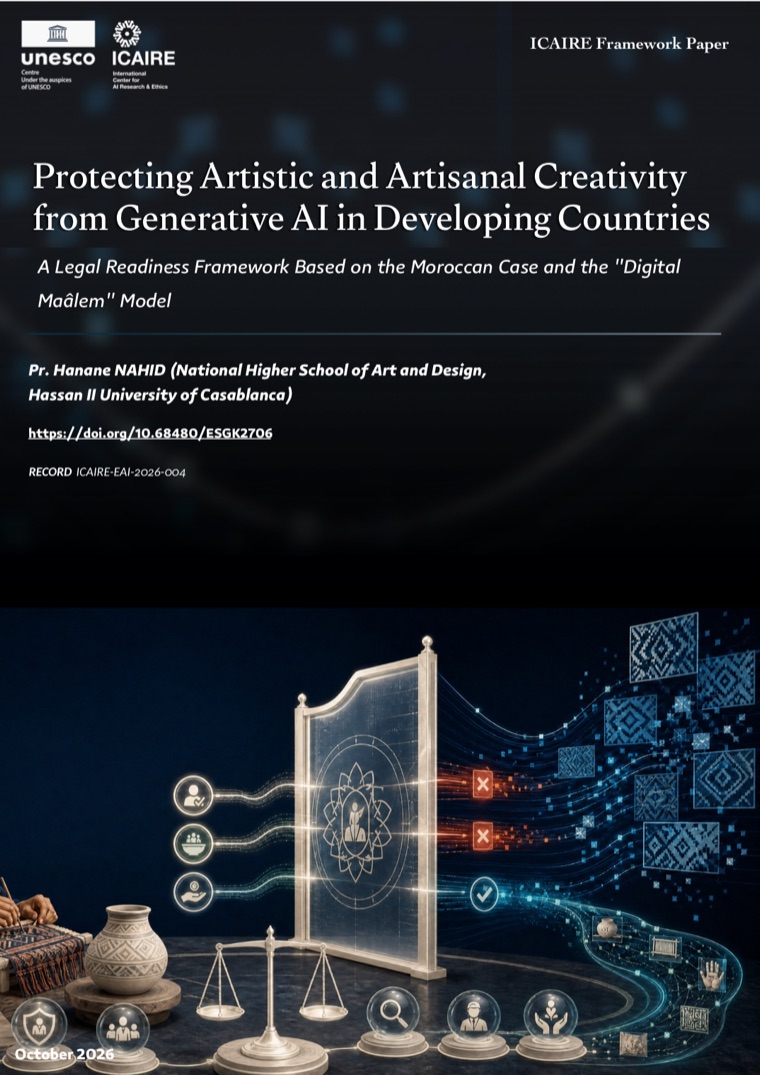
Protecting Artistic and Artisanal Creativity from Generative AI in Developing Countries
A Legal Readiness Framework Based on the Moroccan Case and the "Digital Maâlem" Model
Abstract
Generative models trained on global corpora reproduce the decorative and musical vocabulary of developing countries without consent, attribution or payment, and the artisans who authored those traditions bear the commercial consequence. This paper develops legal readiness as a qualitative conceptual and policy framework for assessing whether a national legal system can respond. The framework structures analysis across four policy axes: the protection of human authorship, training data governance, the safeguarding of folklore and traditional cultural expressions, and judicial capacity. It assigns no indicators, weights or scores to any jurisdiction.
The framework extends UNESCO's Readiness Assessment Methodology (RAM). Morocco has completed a RAM, but its published legal findings concern personal data, the regulation of cyberspace, liability and public procurement, not cultural intellectual property. No readiness instrument currently asks who may license a traditional cultural expression for machine training, what provenance obligations attach to heritage material in a training corpus, or whether a court can establish that a protected work entered a model. That is the gap this framework addresses.
Morocco is examined as an illustrative national case rather than a statistically representative sample of developing countries. Applying the four axes to Moroccan law returns a mixed result. Axis 3 is strong: Article 7 of Law No. 02-00 protects expressions of folklore against reproduction, communication to the public, adaptation and fixation for commercial purposes, vests the authorisation right in the Moroccan Copyright Office, requires that the community or locality of origin be named, and earmarks the sums collected for professional purposes and cultural development. Axis 4 is partial: Law No. 013.26 of 2026 empowers authorised officials to inspect the information systems of users of protected works, which is an evidentiary tool of direct relevance, though its reach to a training corpus held abroad is untested. Axis 2 is indirect. Axis 1 shows no readiness on the express question, since no Moroccan instrument distinguishes AI assisted from AI generated work, and the human authorship requirement that Law No. 013.26 preserves resolves the matter only by implication.
The paper then proposes the Digital Maâlem model, under which AI systems deployed in the artisanal and creative sectors operate under the responsibility of a certified master artisan, paired with a professional digital twin through which an artisan registers technique and draws a statutory remuneration when it is exploited commercially. Both components are anchored on institutions that already exist: the authorisation right of the Copyright Office under Article 7, and the artisan registers maintained by the regional chambers of crafts. Questions of consent, inheritance, attribution of diffuse communal style and cross border enforcement are set out as the conditions the model must satisfy before implementation, and the objections of state custodianship and cultural access are addressed directly. The conclusions are offered as foundational hypotheses and policy pathways for broader comparative research.
Keywords
- legal readiness
- traditional cultural expressions
- generative AI
- intellectual property
- Morocco
- Digital Maâlem
- WIPO
Publication record
- Series
- ICAIRE Ethical AI Series
- Record number
- ICAIRE-EAI-2026-004
- Published
- October 2026
- Type
- ICAIRE Framework Paper
- Persistent link
- https://doi.org/10.68480/ESGK2706
- Review status
- Reviewed by the ICAIRE Scientific Committee
- Status
- Author-attributed, ICAIRE-hosted
- Pages
- 14
- Language
- English
Citation & identifiers
Persistent identifier
https://doi.org/10.68480/ESGK2706Nahid, H. (2026). Protecting artistic and artisanal creativity from generative AI in developing countries: A legal readiness framework based on the Moroccan case and the "Digital Maâlem" model (ICAIRE Framework Paper). International Center for Artificial Intelligence Research and Ethics. https://doi.org/10.68480/ESGK2706