
The question the institutional map left open
A companion article mapped the world's AI-ethics research centers against the ten principles of the UNESCO Recommendation on the Ethics of Artificial Intelligence. It found 202 verified institutions, concentrated in Western Europe and North America, organised overwhelmingly around governance and accountability.
Institutions, however, are not the same thing as research. A center can list a principle among its pillars without publishing on it, and a great deal of work on the ethics of AI is done by authors who belong to no AI-ethics center at all. The obvious next question is what the literature itself is about, measured on the same frame.
This article reports that measurement. ICAIRE assembled a corpus of 3,894 unique papers from six bibliographic sources, verified a random sample against the authoritative indexes, and classified each paper against the ten principles. The result is not a smaller echo of the institutional map. The literature is organised around safety and security, accountability, and transparency; awareness and literacy, which is the fourth-largest preoccupation of the institutions, is the subject of roughly one paper in thirty.
What the literature studies
Every paper in the corpus carries a classification against the ten principles, assigned from its title and abstract. A paper addresses fewer principles than an institution does: the average is 1.8, against 4.9 for a research center, because a paper makes one argument while a center runs a programme. The distribution across the ten is therefore narrower, and more revealing.
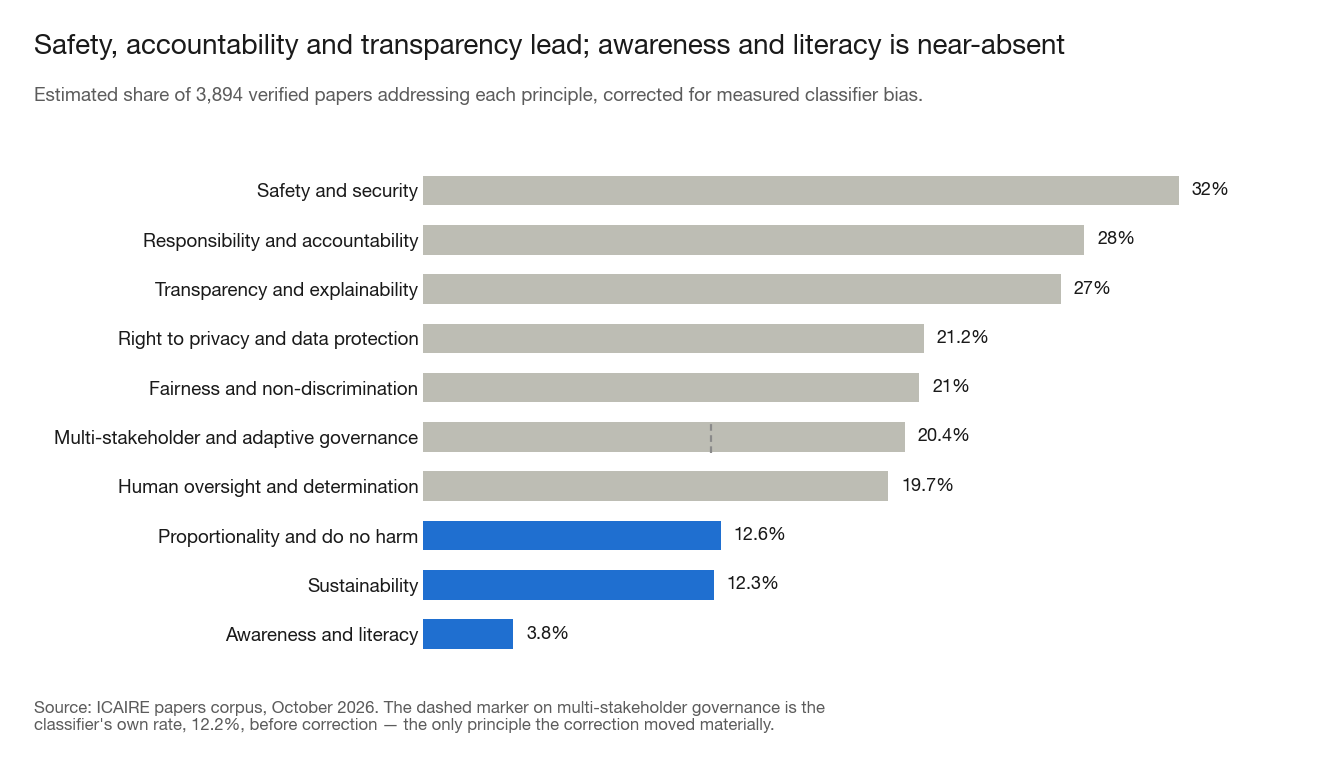
Safety and security is the single largest subject, addressed by an estimated 32% of papers. Responsibility and accountability follows at 28%, transparency and explainability at 27%, and fairness and non-discrimination at 21%. These four account for most of the field.
At the other end, awareness and literacy is addressed by an estimated 3.8% of papers, roughly one in twenty-six. Sustainability reaches 12.3% and proportionality and do-no-harm 12.6%. The thinness of proportionality echoes the institutional map, where it was also among the weakest principles, but the thinness of awareness and literacy is new and much sharper.
One principle required correction. The classifier tagged multi-stakeholder governance on 12.2% of papers, but independent re-judgment of the verification sample found it in 20.4%, a gap well outside the margin of error and the only tagging bias that survived every robustness check. The classifier reliably recognises a paper about an algorithm and reliably misses a paper whose frame is a regulatory instrument such as the European Union's AI Act. Figure 1 shows the corrected estimate, with the classifier's own rate marked for comparison.
How attention has rotated
The corpus spans 1998 to 2027, but it is overwhelmingly recent: 3,089 of the 3,894 papers are dated 2024 or later, and the annual count rises from 142 in 2019 to 966 in 2025. That growth alone is a finding about the field. More interesting is what the field moved on to.
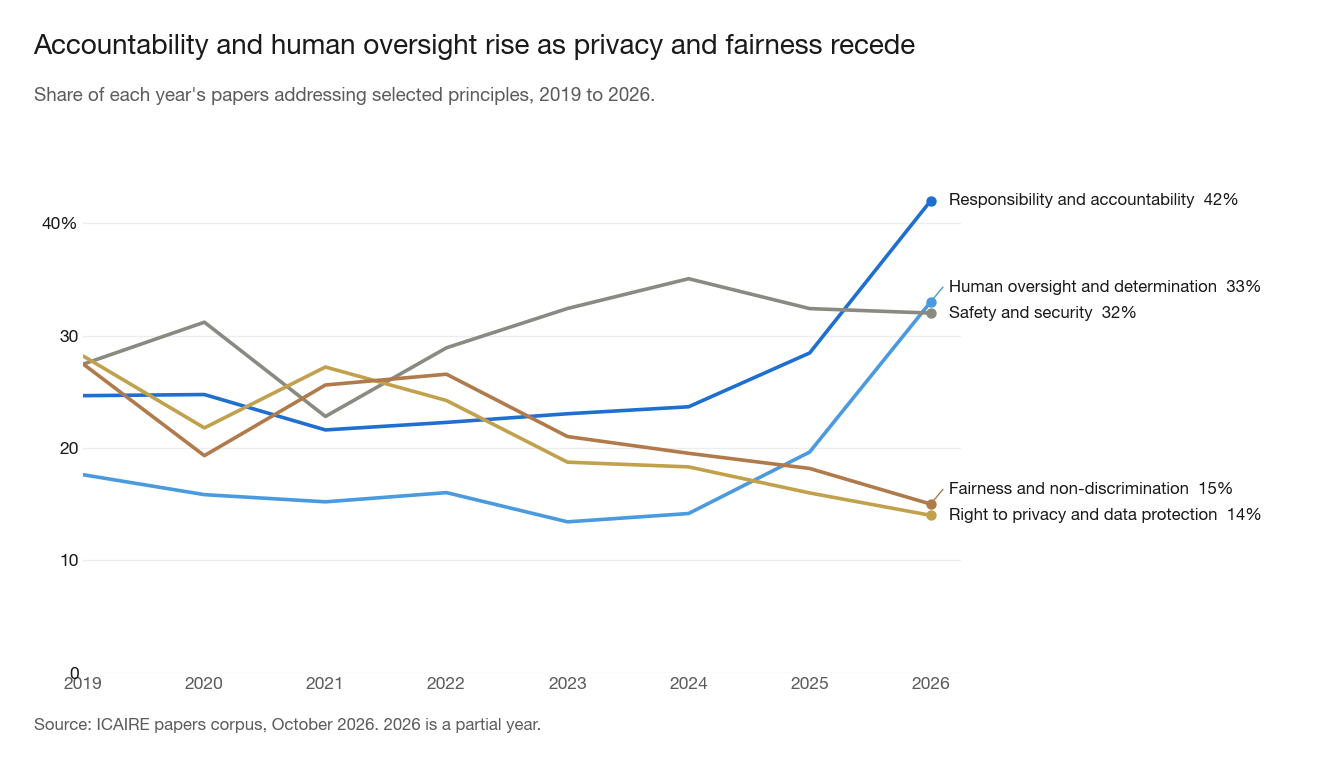
Two principles have fallen steadily. Privacy and data protection was addressed by 28% of papers in 2019 and 14% in 2026. Fairness and non-discrimination fell from 28% to 15% over the same period. Neither has disappeared, but the share of the field's attention they command has roughly halved.
Two have risen sharply, and almost entirely in the last two years. Responsibility and accountability moved from 23% of papers in 2024 to 42% in 2026. Human oversight and determination moved from 14% to 33% across the same two years, having been flat or declining for the previous five. Safety and security, by contrast, has been stable at about a third of the field since 2020.
The timing points to a cause. Accountability and human oversight are the two principles that matter most once AI systems begin to act rather than only to predict, and the rise coincides with the arrival of agentic systems as a mainstream research subject. The rotation is not an artefact of the corpus: because the mix of collection sources shifts across the period, the trend was re-run inside each source separately, and the direction and approximate size of every movement shown replicates independently in arXiv, Crossref and OpenAlex. Within arXiv alone, accountability rises 28 points and human oversight 26 points between 2019 and 2026, while fairness falls 23 points.
Where the institutions and the literature diverge
The companion analysis coded each institution's declared mandate against the same ten principles, so the two bodies of evidence can be set side by side — but not through their raw percentages. A mandate is written to be broad and a paper to be narrow, so every principle appears more often among centers than among papers whatever the underlying priorities. Expressing each principle as its share of all the principle attention within its own body removes that difference. The question becomes not how often a principle is mentioned, but how a finite quantity of attention is divided.
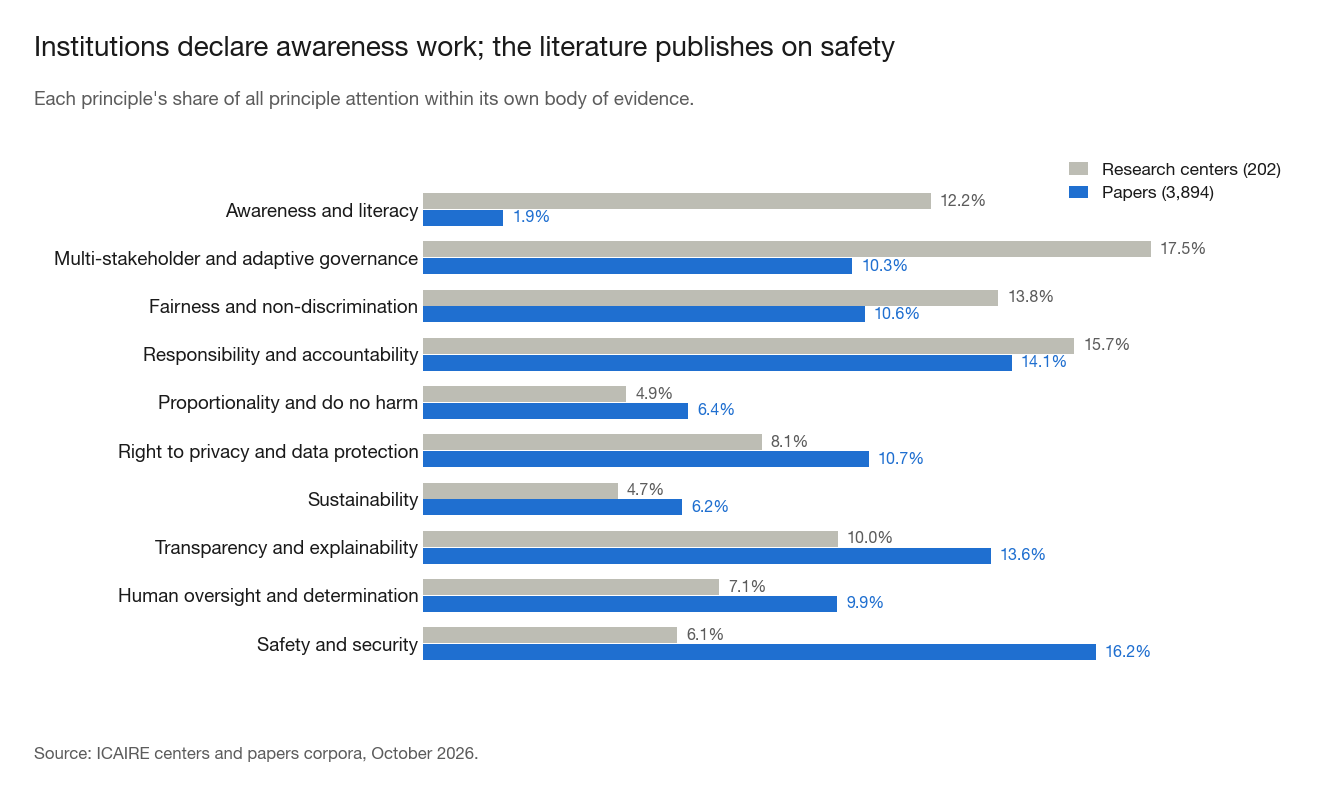
The two rank orders correlate weakly and not significantly (Spearman's rho = 0.33, p = 0.35). With only ten principles the test has very little power, so this result establishes neither agreement nor disagreement between the institutional agenda and the published literature; it is an absence of evidence rather than evidence of absence. The informative comparison is principle by principle, and three divergences are large enough to survive the uncertainty in both estimates.
The sharpest is awareness and literacy. It takes 12.3% of the attention declared by research centers, where it ranks fourth of the ten principles, and 1.9% of the attention of the literature, where it ranks last. Public AI literacy is, on this evidence, something institutions undertake as a mission and almost never pursue as a research question: the activity exists in quantity, and the scholarship that would evaluate whether it works does not. Multi-stakeholder governance diverges in the same direction, though less severely, at 0.59 times the institutional share, as does fairness and non-discrimination at 0.77 times.
Public AI literacy is, on this evidence, something institutions undertake as a mission and almost never pursue as a research question.
Safety and security diverges in the opposite direction, and by the largest multiple: 16.2% of the attention of the literature against 6.1% of the attention of institutions, a ratio of 2.66. Transparency and human oversight follow the same pattern at roughly 1.4 times. These are the principles where published research has moved ahead of the stated institutional mandate, and two of the three are where the literature is still accelerating.
One caution applies throughout. A center was coded from what it says it does, a paper from what it demonstrably studied, and a declared mandate is cheaper to write than a published result. The divergences describe where attention is directed, not which body of work is more substantial.
What this means for implementation
The Recommendation asks member states to act on all ten principles. It does not ask the research community to study them in equal measure, and nothing in these figures suggests it should. But implementation is supposed to rest on evidence, and where the evidence base is thin the commitment rests on assertion instead.
Awareness and literacy is the clearest case. It is among the most widely declared institutional priorities and the least studied question in the literature, by a factor of roughly six. Member states are building AI literacy programmes, and almost nothing is being published on which of those programmes work, for whom, or at what cost. The same pattern, less severely, affects multi-stakeholder governance: institutions describe governance work in their mandates far more often than researchers publish on it.
The opposite imbalance carries its own risk. Safety and security absorbs more than a sixth of the attention of the literature and is still rising, and accountability has nearly doubled its share in two years. These are not neglected questions but questions where the published base is growing faster than the institutional capacity able to absorb it, and the useful intervention there is translation rather than more research.
One qualification belongs with any reading of these numbers. Around 12% of the corpus is not an AI-ethics contribution at all on close inspection, and the collection pipeline recovers only about seven in eight of the principles a human reader would assign. The literature is therefore somewhat smaller, and somewhat differently distributed, than an uncorrected count of the records would suggest.
How the corpus was built and verified
The collection began with an automated search of six bibliographic sources — arXiv, Crossref, OpenAlex, IEEE Xplore, Springer and Elsevier — against a standing set of AI-ethics query terms, exported in three batches. That search returned 3,935 records. Deduplication on the digital object identifier, falling back to a normalised title where no identifier exists, removed 41 records, 34 of which had been collected by more than one of the three batches. The analysis corpus is 3,894 unique papers. Each record arrived with an automatic classification against the ten principles, derived from its title, abstract and generated summary.
Verifying every record individually was not feasible at this scale, so verification proceeded by sampling. A stratified random sample of 183 papers was drawn, stratified by collection source and allocated in proportion to each source's share of the corpus, with a floor to ensure the smallest sources were represented. Each sampled paper was then examined in three ways: its existence and metadata were checked against an authoritative bibliographic record; its subject was judged against the question of whether it is an AI-ethics contribution at all; and its principles were re-assigned independently from the paper's own text, using the definitions set out in the Recommendation, and only then compared with the automatic tags.
The results of that audit govern every figure in this article. Every sampled paper traced to a real publication and none was fabricated. Roughly 12%, with a margin of about five percentage points, fall outside AI ethics. The automatic classification is accurate when it fires — 94% of its tags were supported by the text — and incomplete, recovering 87% of the principles a reader would assign.
Because the audit measures the direction of that error as well as its size, the corpus figures reported here are not the raw tag counts: each principle's prevalence is the tagged rate adjusted by the bias measured in the sample. Only multi-stakeholder governance moved materially under that correction, from 12.2% as tagged to an estimated 20.4%. The year-by-year movements were checked separately against the possibility that they reflect a changing mix of sources rather than a changing literature; every trend shown holds within each collection source taken on its own.
The dataset, and what follows
The verified corpus is published alongside this article as an explorable dataset: 3,894 papers with their principle assignments, the full audit sample with its per-paper judgments, the classifier accuracy measures, and the quality flags that any reuse should take into account — records without an identifier or abstract, low-confidence classifications, and the small number of items with disputed publication years.
This is the second piece in ICAIRE's first publication collection. The first mapped the world's AI-ethics research centers against the same ten principles and is where the institutional figures used here come from. A third will take the two together and examine whether the regions that host the most institutional capacity are also the regions producing the literature — a question this corpus can only partly answer, since more than half of its papers carry no usable affiliation.