The question the Recommendation left open
In November 2021, the 193 member states of UNESCO adopted the Recommendation on the Ethics of Artificial Intelligence, the first global normative instrument on the subject. The Recommendation articulates ten principles, from proportionality and do-no-harm to multi-stakeholder and adaptive governance, and calls on member states to translate them into policy. It does not, and could not, specify who would produce the research on which such policy depends: which institutions, in which countries, and on which of the ten principles.
This article reports the results of an exercise designed to answer that question. ICAIRE compiled a directory of research centers worldwide that present the ethics of AI as a core mandate or as an explicit pillar of their work, verified each entry against the institution's own public record, and classified the work each center demonstrably carries out using the ten principles as the frame of reference. The findings can be stated in one sentence: institutional capacity for AI-ethics research is uneven in two respects at once. It is concentrated in a single region, and it concentrates on governance and accountability while proportionality, sustainability, and safety have almost no institutional home outside Western Europe, North America, and Eastern Europe.
Where the centers are
The directory contains 202 verified, active centers. Ninety-eight of them, almost half, are located in Western Europe and North America; the United States alone accounts for 20, the United Kingdom for 11, and Canada for 8. Asia and the Pacific follows with 35 centers, Eastern Europe and Africa with 20 each, Latin America and the Caribbean with 19, and the Arab States with 10. Seventy-four of the 194 member states host at least one center; 120 host none.
Raw counts describe where the research community is located, but they are a poor basis for comparing regions of very different size: a region of 26 member states and one of 47 cannot be judged by the same number. Figure 1 therefore places three indicators side by side. The first is volume, the number of verified centers. The second is coverage, the number of a region's member states that host at least one center, which measures how widely the research base is spread across the region's governments. The third is range, the number of the ten principles for which the region has at least one center treating that principle as a primary subject, which measures how completely the region's institutions span the Recommendation.
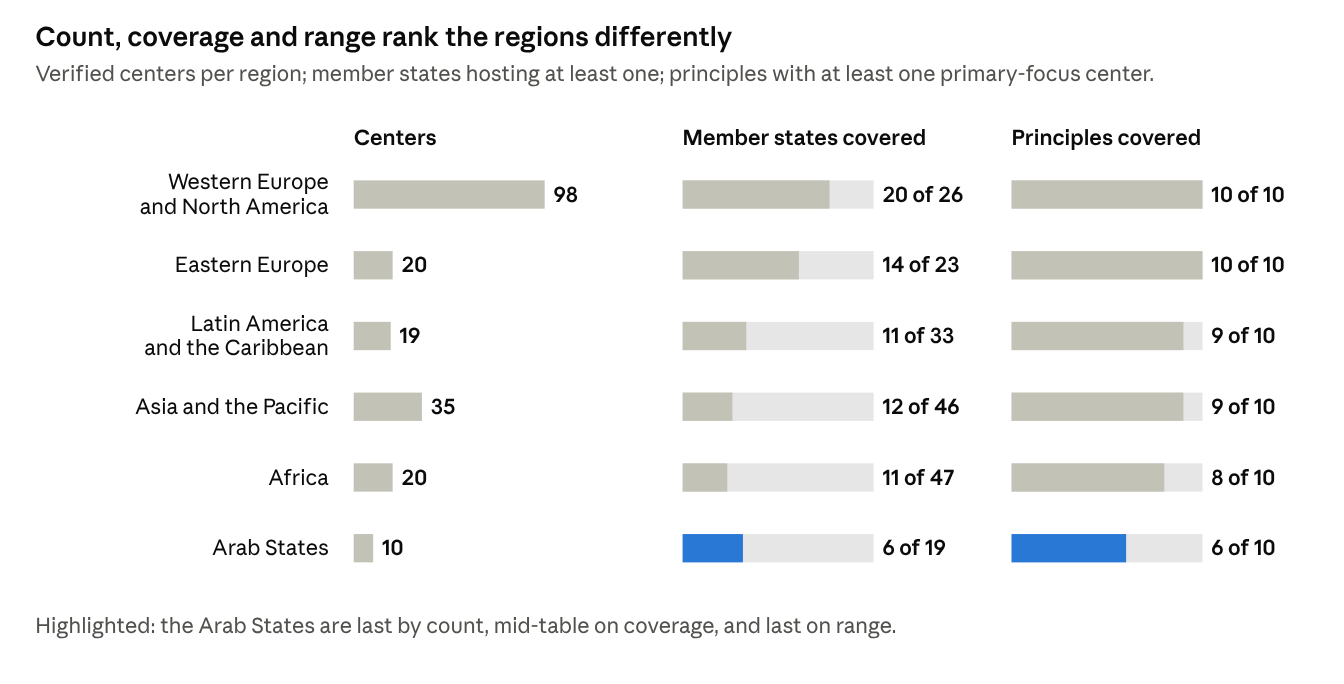
The ranking changes with the indicator. Western Europe and North America leads on all three, with 98 centers, 20 of its 26 member states covered, and every principle represented. Asia and the Pacific is second by volume but covers only 12 of its 46 member states. Africa is fifth by volume and last by coverage, with 36 of its 47 member states uncovered and seven of its 20 centers in a single country, South Africa. The Arab States are last by volume, yet six of their 19 members host a center, a wider coverage than Asia and the Pacific or Africa: three in the United Arab Emirates, two each in Oman and Qatar, and one each in Egypt, Morocco, and Saudi Arabia. What the region lacks is not presence but range: for four of the ten principles, no center in the Arab States treats the principle as a primary subject.
A country absent from the directory is one in which no verified center was found, not necessarily one in which none exists; web-based collection favours institutions with an English-language presence.
What the centers work on
Each center was classified against the ten principles on the basis of what its own pages document: a named programme, research line, project, publication, or service. A principle mentioned only in a mission statement was not counted. On that criterion the typical center works on five of the ten principles, and the distribution across principles is markedly uneven (Figure 2).
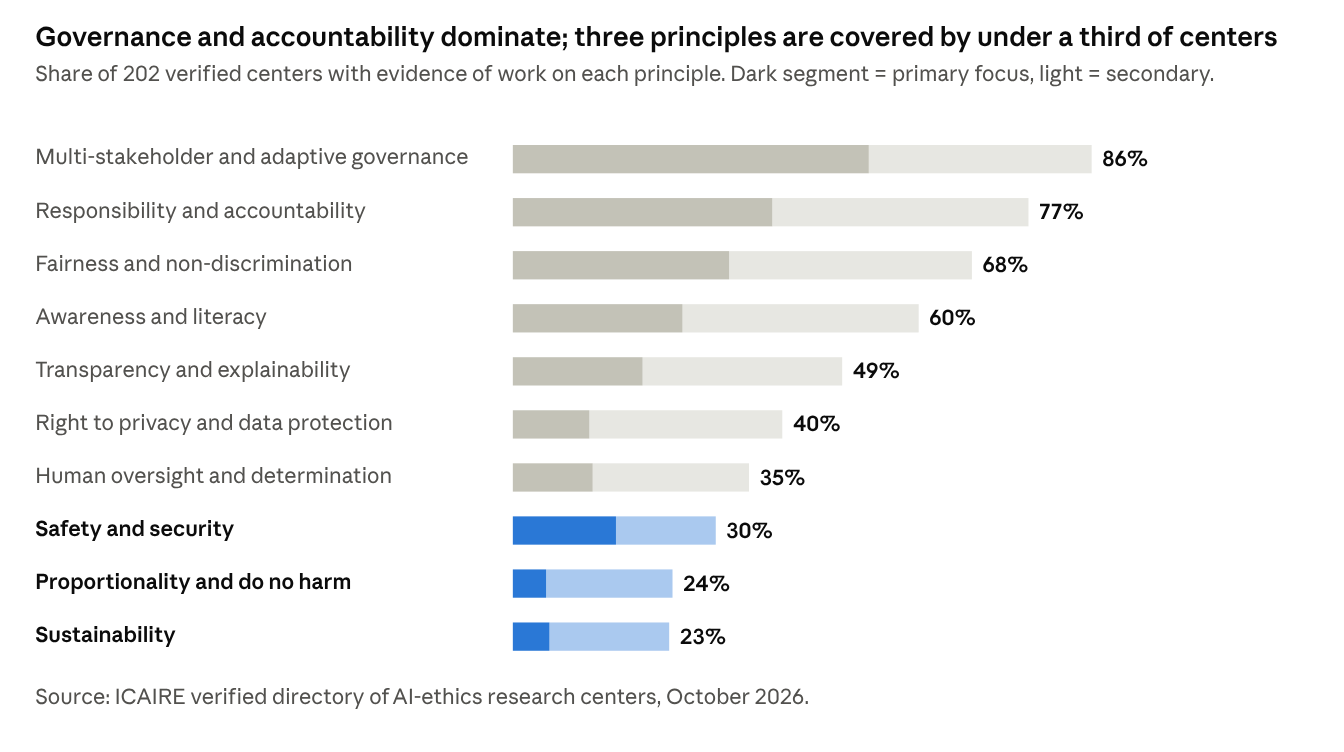
Multi-stakeholder and adaptive governance appears in the work of 86% of centers and is the primary subject of 107 of them, more than any other principle. Responsibility and accountability follows at 77%, fairness and non-discrimination at 68%, and awareness and literacy at 60%. These four principles constitute the mainstream of institutional research on the ethics of AI.
The other end of the distribution is the more consequential finding. Proportionality and do-no-harm, the principle that carries the Recommendation's requirement for risk assessment and its prohibitions on social scoring and mass surveillance, is evidenced in 24% of centers and is the primary subject of only ten worldwide. Sustainability, which covers the environmental and developmental footprint of AI, stands at 23% and eleven. Safety and security reaches 30%, and the 31 centers that treat it as a primary subject form a narrow community: 21 in Western Europe and North America and 7 in Asia and the Pacific.
The pattern is unlikely to reflect a judgement that these principles matter less. Governance and accountability are where regulatory activity, funding, and policy demand have concentrated since 2021, and research institutions follow demand. Proportionality and sustainability pose questions that are harder to fund and harder to answer: whether a given AI system should be deployed at all, and what it costs the environment.
Regional signatures
Crossing the two lenses, geography and principle, moves the analysis from quantity to character. Each region has a recognisable signature (Figure 3), and the global North and South are, in effect, conducting different conversations about the ethics of AI.
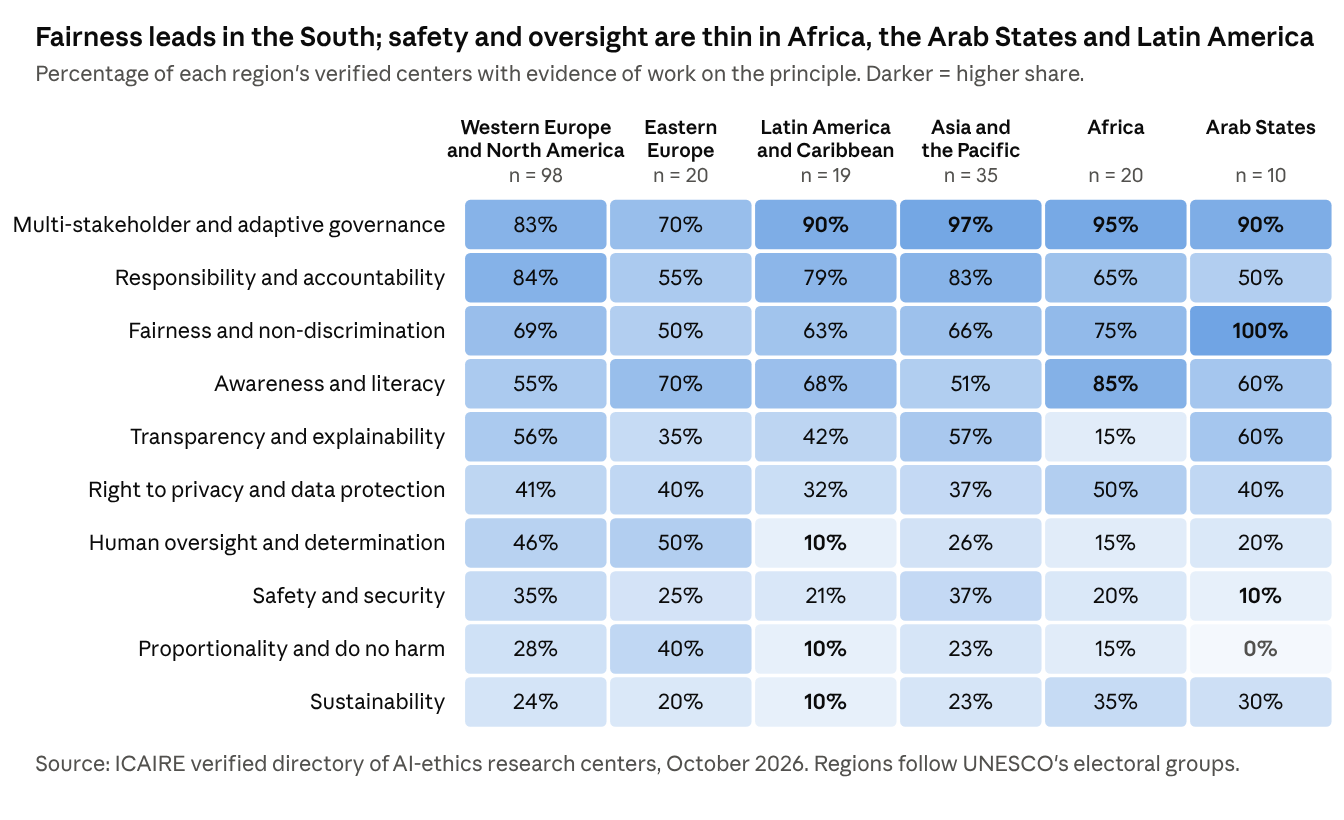
Governance is the single near-universal theme, evidenced in more than 80% of centers in every region except Eastern Europe. Below that line the regions diverge. Fairness and non-discrimination, framed as inclusion, digital divides, and locally relevant AI, is the signature of the South: 100% of centers in the Arab States and 75% in Africa work on it, against 69% in Western Europe and North America. Sustainability follows the same pattern, stronger in Africa (35%) and the Arab States (30%) than in Western Europe and North America (24%), carried by development-oriented laboratories that tie AI to the Sustainable Development Goals.
The technically demanding principles run the other way. Human oversight and determination is studied by 46% of centers in Western Europe and North America and 50% in Eastern Europe, but by 26% in Asia and the Pacific and between 10% and 20% in Latin America and the Caribbean, Africa, and the Arab States. Transparency and explainability is evidenced in 56% of centers in Western Europe and North America and 15% in Africa. Safety and security stands at 35% in Western Europe and North America and between 10% and 20% in Africa and the Arab States. Proportionality and do-no-harm is the emptiest row of the matrix: all ten centers that treat it as a primary subject are located in Western Europe, North America, or Eastern Europe.
The institutional mandates behind the figures explain the divergence. Twenty-two of the world's 37 centers devoted to the philosophy and ethics of technology, 12 of the 17 technical responsible-AI laboratories, and all 8 standards and audit bodies are located in Western Europe and North America. African centers are predominantly applied and development-oriented, and include four of the world's nine sector-specific laboratories. Latin America and the Caribbean is the most legally and civically oriented region, home to half of the digital-rights advocacy organisations in the directory. Asia and the Pacific is policy-oriented and hosts the second AI-safety cluster, six centers across China, Japan, the Republic of Korea, and Australia. The Arab States are oriented towards governance and capacity building, with one technical center and no safety center.
Percentages for Africa and the Arab States should be read as indications of direction rather than precise rates: with 20 and 10 centers respectively, a single center shifts a cell by five or ten percentage points.
The gaps that matter
Proportionality and do-no-harm is the emptiest row of the matrix: all ten centers that treat it as a primary subject are located in Western Europe, North America, or Eastern Europe.
Three distinct gaps follow from the map.
The first is a principle without an institutional home. Proportionality and do-no-harm is where the Recommendation draws its firmest lines: on social scoring, on mass surveillance, and on human determination in decisions that cannot be reversed. Ten centers worldwide study it as a primary subject, and none is located in Latin America and the Caribbean, Asia and the Pacific, Africa, or the Arab States, the regions in which those lines are most likely to be tested first. Sustainability occupies a similar position: eleven primary-focus centers, and the one region in which it is relatively prominent, Africa, approaches it as development impact rather than as the environmental cost of AI.
The second is a gap in regional range. The Arab States host ten active centers, yet no center in the region treats proportionality, safety, sustainability, or human oversight as a primary subject. A region can be present in the field while having no institution working on four of its ten principles. The same pattern, less sharply, holds for Africa, which has no primary-focus center on proportionality or on transparency and explainability.
The third is the 120 member states with no verified center at all, among them Pakistan, Bangladesh, Iran, Viet Nam, Malaysia, the United Republic of Tanzania, Angola, Algeria, Iraq, and Jordan. For these countries the Recommendation remains a text without a domestic research base to interpret it.
For member states, the practical implication is that the national conversation on the ethics of AI, where one exists, is almost certainly a conversation about governance and fairness, while the questions of whether a system should exist, how safe it is, and what it costs the environment are being asked elsewhere. For ICAIRE, the implication is a mandate: a UNESCO Category 2 centre in the Arab region that adopted proportionality, sustainability, and safety as research pillars would duplicate no existing institution. It would occupy the emptiest cells of the map.
How the map was built
The directory covers all 194 UNESCO member states, grouped according to UNESCO's electoral regions. Candidate institutions were identified through a systematic scan of each member state for research centers, institutes, laboratories, observatories, and programmes that present the ethics of AI as a core mandate or as an explicit pillar of their work. Each candidate was then verified against its own public record: the existence and current activity of the institution, its location and affiliation, and the accuracy of its official website. The 202 centers that passed verification constitute the directory.
Each verified center was then classified on three dimensions, drawing on the evidence of its own pages rather than on its self-description: the type of entity (university center, independent institute, public body, network, or programme within a larger institution); its mandate theme (for example governance and public policy, philosophy and ethics of technology, technical responsible AI, or sector-specific applied ethics); and the UNESCO principles on which it demonstrably works, each recorded as a primary or a secondary subject. A principle was credited only where a named programme, research line, project, publication, or service supported it, and the supporting evidence is recorded for every entry. Regional comparisons use the UNESCO member-state lists as denominators and rounded 2024 United Nations population estimates. The full protocol, the classification rules, and the row-level dataset are published in the companion Data and Methods Note.
The directory and the collection
The directory is published as an open, interactive dataset. Every center can be explored by region, country, entity type, mandate theme, and principle, together with the evidence behind each classification, and the dataset is refreshed monthly as new centers are verified and existing entries change. Institutions that are missing, misdescribed, or have moved are invited to submit a correction for the next release.
This article is the first in ICAIRE's collection on the ethics of AI and provides its institutional lens. The second article applies the same ten-principle frame to the published literature, mapping research output rather than research institutions. A third examines where the two lenses disagree: principles that are widely written about but lack an institutional home, and regions that publish without hosting a center. Together, the three are intended to give member states and UNESCO a single, evidence-based picture of where the Recommendation is being studied and where it is not.
Next in the collection · Article 2 of 2
What AI ethics research actually studies: 3,894 papers against UNESCO's ten principles
Read it now